“So, uh, would you mind leaving us a review?”
Every tradesperson has said it. Standing at the customer’s door, tools packed away, invoice paid. You know you should ask. But it comes out awkward, rushed, and half the time the customer says “Yeah, sure” — and then never does it.
You’re not alone. Most tradespeople rely on asking in person, which means reviews depend entirely on whether you remember to ask, whether the customer remembers to do it, and whether either of you can be bothered after a long day.
The result? Most trades businesses have fewer than 20 Google reviews. And that’s costing them real money.
Why Reviews Matter More Than You Think
Let’s talk numbers, because this isn’t about vanity.
A one-star improvement in your Google rating translates to a 5-9% increase in revenue. That’s not a marketing claim — it’s from Harvard Business School research on Yelp data, and the pattern holds across local service businesses.
Businesses with 50+ reviews earn 35% more than those with fewer than 10. Google’s own local search algorithm heavily favours businesses with more recent, higher-rated reviews. More reviews = higher ranking = more clicks = more jobs.
And here’s the one that should make you pay attention: 93% of consumers say online reviews influence their purchasing decisions. For local trades, where trust is everything, reviews are your single biggest trust signal. Not your website. Not your logo. Not your van wrap. Your reviews.
When a homeowner in Birmingham searches “electrician near me” and sees one business with 8 reviews and another with 47, they’re calling the one with 47. Every time.
Why Most Tradespeople Have Fewer Than 20 Reviews
It’s not because the work is bad. It’s because the system is broken.
- They rely on asking in person. This works about 10% of the time. The customer says yes, walks inside, makes a cup of tea, and completely forgets.
- They forget to ask. After 8 hours of physical work, remembering to ask every single customer for a review isn’t realistic. You’re thinking about the next job, not marketing.
- They feel awkward about it. Asking for a review feels like asking for a favour. Most tradespeople would rather just do good work and hope the reviews come naturally. They don’t.
- Customers mean to but never do. Even happy customers rarely leave reviews unprompted. It’s not that they don’t want to — they just don’t think about it once you’ve left. Life gets in the way.
The gap between “satisfied customer” and “published Google review” is where most trades businesses lose. And it’s entirely fixable.
The 5-Step System to Get 20 Reviews in 30 Days
1. Timing Is Everything
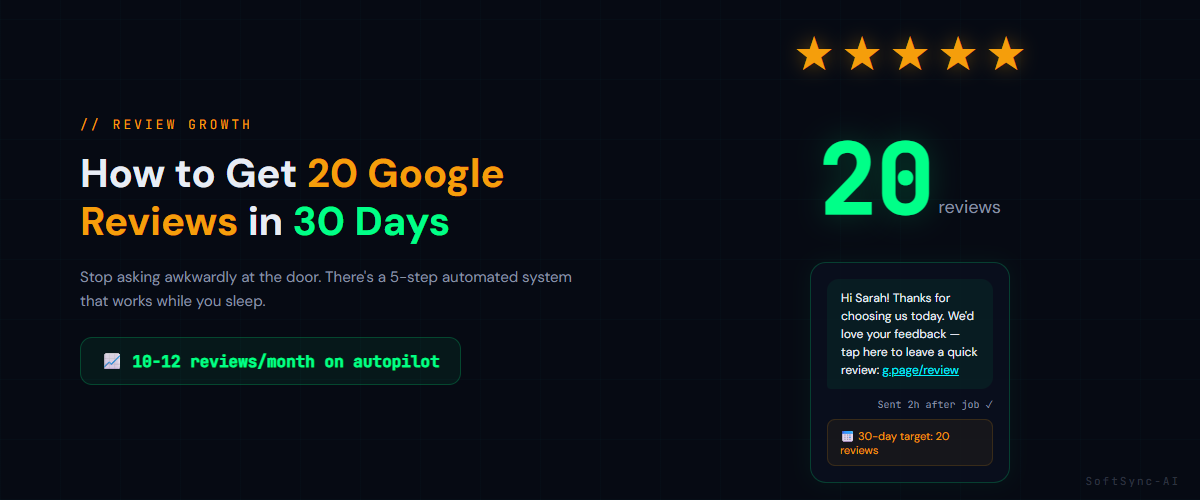
Send the review request 2-4 hours after job completion, while the customer is still happy and the experience is fresh. Not the same evening when they’re watching telly. Not the next morning when they’ve moved on to other things.
The sweet spot is the afternoon of the job. The kitchen is clean, the boiler is working, the lights are on. They’re still feeling grateful. That’s when you ask.
Studies on review timing show that requests sent within 2-4 hours of service completion get 3x the response rate compared to next-day requests. The emotional window closes fast.
2. Make It Stupidly Easy
One tap. One link. Directly to your Google review page.
Don’t send them to your website. Don’t ask them to “search for us on Google.” Don’t give them instructions. Every extra step you add cuts your conversion rate in half.
Google lets you generate a direct review link for your business. When the customer taps it, they see the star rating and a text box. That’s it. Five seconds and they’re done.
The easier you make it, the more reviews you get. This isn’t complicated — it’s just that most people overcomplicate it.
3. Use the Right Channel
SMS has a 98% open rate compared to 20% for email. WhatsApp is even better for trades, because it’s the channel your customers already use to message you about the job.
If you’ve been communicating with the customer via WhatsApp (which most UK tradespeople do), send the review request there. It feels natural, it’s in a conversation they’re already checking, and they’re far more likely to tap the link.
Email review requests are where reviews go to die. Your message lands between a Tesco Clubcard email and a reminder about car insurance. It gets ignored. Use the channel the customer actually reads.
4. Follow Up Once
If they haven’t left a review in 3 days, send one polite reminder.
“Hi [name], just checking if you had a chance to share your feedback. Here’s the link again: [link]. No worries if not — thanks again for choosing us!”
One follow-up. Not five. Not a weekly nagging campaign. One gentle nudge is enough to catch the people who meant to do it but forgot. More than that and you’re annoying your customers — which is the opposite of what you want.
That single follow-up typically converts an additional 15-25% of non-responders. It’s the highest-ROI message you’ll ever send.
5. Automate All of It
Here’s where it comes together. Set up a workflow that triggers automatically when a job is marked complete in your system. The AI sends the review request at the right time, via the right channel, with the direct link. It waits 3 days. If no review appears, it sends the one follow-up.
Zero manual effort. You finish the job, mark it done, and the system handles the rest. No awkward conversations. No forgetting. No evening admin.
You go from “I should ask for a review” to “reviews just appear in my Google profile” without changing anything about how you work.
The Maths
Let’s be realistic about the numbers.
If you complete 25 jobs in a month and 80% of those customers get an automated review request, that’s 20 requests sent. If 40% of those leave a review, that’s 8 reviews in month one.
With the follow-up nudge boosting conversions by another 15-25%, you’re looking at 10-12 reviews per month.
In 30 days: 10-12 new reviews. In 60 days: 20-24 new reviews. By summer, you’re sitting on 50+ reviews and outranking every competitor in your area who’s still asking awkwardly at the door.
Bonus: Intercept Negative Feedback Before It Goes Public
Here’s something most people don’t think about. When you automate review requests, you can also build in a sentiment filter.
Before sending the customer to Google, ask a simple question: “How was your experience?” If they respond positively, send them straight to the review page. If they respond with anything negative — a complaint, a concern, a frustration — route it directly to you instead.
Now you have a chance to fix the problem before it becomes a 1-star public review. Call the customer, address the issue, make it right. Most of the time, a quick response turns a potential 1-star review into a 4 or 5-star review — because the customer is impressed that you actually cared enough to follow up.
This alone can save you from the devastating impact of negative reviews. One 1-star review can undo the trust built by ten 5-star reviews. Prevention is worth infinitely more than damage control.
Your Competitors Are Still Asking at the Door
While other tradespeople in your area rely on memory and awkward conversations, you could have a system that consistently generates 10-12 reviews per month on autopilot.
By summer, you’re at 50+ reviews. You’re ranking higher on Google. You’re the obvious choice when a homeowner compares you to the bloke with 6 reviews from 2023.
And you never had to ask a single customer awkwardly at their front door.
SoftSync-AI automates review collection, follow-ups, and negative feedback interception for UK trades businesses. Live in 3 days.
Ready to automate your reviews?
Book a free 30-minute AI audit and we’ll map exactly how review collection, follow-ups and negative feedback interception would work for your business.
Let’s talk →