Dave is a solo plumber in Milton Keynes. He’s good at his job. 4.8 stars on Google. Fully booked most weeks. But he’s under boilers eight hours a day — and his phone rings while his hands are full of copper pipe.
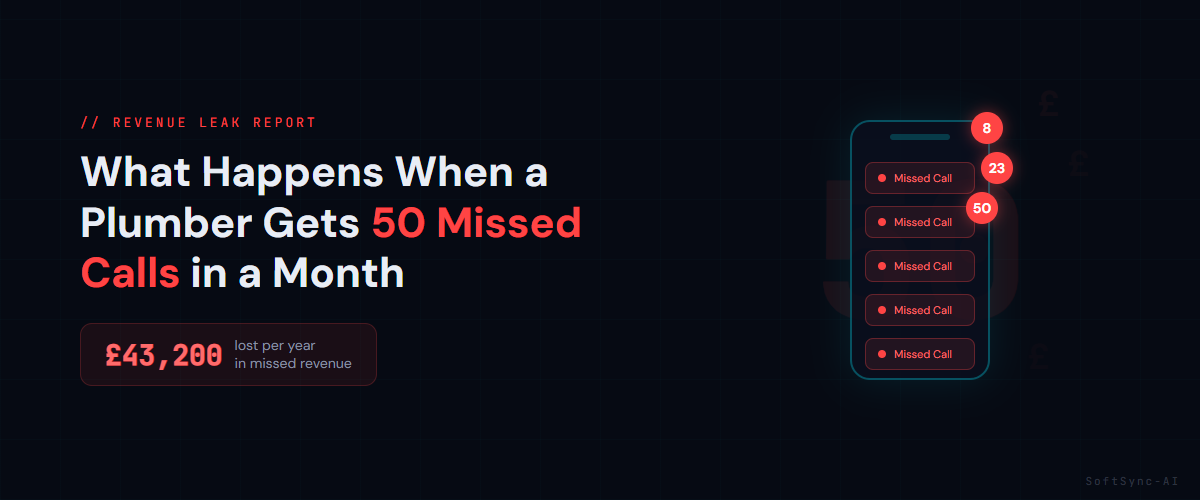
Last month, Dave had 50 missed calls. He knows this because he checked his call log on a Sunday morning, cup of tea in hand, feeling slightly sick about it.
Fifty calls he didn’t pick up. Not because he’s lazy. Not because he doesn’t care. Because he was doing the job he’s brilliant at — and you can’t solder a joint and answer the phone at the same time.
Let’s walk through what those 50 missed calls actually cost him.
Step 1: How Many Were Real Leads?
Not every missed call is a lost job. Some are existing customers ringing about an ongoing job. Some are spam. Some are his mum.
But industry data tells us that roughly 60% of inbound calls to trades businesses are genuine new enquiries. People with a problem, looking for someone to fix it, right now.
50 missed calls × 60% = 30 real enquiries Dave never spoke to.
Thirty people who had a leaky tap, a broken boiler, a blocked drain, or a bathroom that needed fitting. Thirty people who picked up the phone, found Dave on Google, liked his reviews, and rang him.
And got voicemail.
Step 2: How Many Would He Have Booked?
Not every enquiry turns into a job, of course. Some are just getting quotes. Some want work done in three months. Some are tyre-kickers.
But here’s what the data says about first response: businesses that respond within five minutes are 21 times more likely to qualify a lead than those who respond after 30 minutes. And 78% of customers book with the first business that responds — not the cheapest, not the most experienced, the fastest.
For a tradesperson who actually answers the phone? Conversion rates on inbound calls sit around 40%. These aren’t cold leads. These are people who already have a problem and actively searched for someone to fix it. They’re warm.
30 real enquiries × 40% conversion = 12 jobs Dave didn’t book.
Step 3: What Were Those Jobs Worth?
Dave’s average job value is £300. Some are £95 emergency call-outs. Some are £600 bathroom fits. Some are £150 tap replacements. Averaged out: £300.
12 lost jobs × £300 = £3,600 in revenue Dave handed to his competitors last month.
Not lost to bad reviews. Not lost to undercutting. Lost to silence.
Break It Down Weekly
That’s roughly 3 jobs per week walking out the door. Three times every week, someone rings Dave, gets no answer, and rings the next plumber on Google instead.
Three jobs. Every single week. While Dave is doing excellent work for the customers he already has.
The cruel irony is that the better Dave gets — the more in-demand he becomes — the more calls he misses. Success creates the very problem that caps his growth.
The Compounding Effect Over a Year
Here’s where it gets properly painful.
£3,600 per month × 12 months = £43,200 in lost revenue per year.
That’s not a rounding error. That’s a second van. That’s an apprentice’s salary. That’s the difference between a solo operation and a growing business.
And it compounds. Every job Dave doesn’t do is a customer who never leaves him a Google review. Every review he doesn’t get is a fraction less visibility in local search. Every fraction less visibility means fewer calls next month. The flywheel works in reverse.
Meanwhile, the plumber down the road who does answer — or has someone answering for him — is collecting those jobs, those reviews, and that momentum.
The Hidden Costs Nobody Talks About
The £43,200 figure is just the direct revenue loss. There’s a whole layer underneath it that’s harder to quantify but just as real.
The 9pm callback cycle. Dave finishes work at 5. Has his tea. Puts the kids to bed. Then at 9pm, he sits down and starts returning the day’s missed calls. Half the time, people don’t answer — because who picks up from an unknown number at 9pm? The ones who do answer? “Sorry mate, already got someone.” He’s doing an hour of unpaid admin every evening for a return rate of maybe 20%.
The stress tax. Every tradesperson I’ve spoken to describes the same feeling: a low-level anxiety about their phone. They know they’re missing calls. They know each one might be a £500 job. But they can’t do anything about it while they’re working. It sits in the back of your mind all day — a problem with no solution.
The reviews that never happen. You can’t get a five-star review from a customer you never had. Every missed call is a missed review. Over a year, that’s potentially 50-100 reviews Dave never collected — reviews that would have pushed him higher in local search, brought in more calls, and created a virtuous cycle instead of a vicious one.
The reputation damage you can’t see. When someone calls a business and nobody answers, they form an opinion. “Must not be very professional.” “Must be too busy for my job.” “Must not care.” None of those things are true about Dave. But perception is reality, and he never gets the chance to correct it.
Why the Traditional Fixes Don’t Work
Dave’s tried a few things. They all fall short.
Voicemail: 80% of callers hang up when they hear it. The ones who do leave a message? By the time Dave calls back, most have already booked someone else.
Asking his partner to answer: Works sometimes, but she’s got her own job. And she can’t check Dave’s calendar, doesn’t know his availability, can’t quote accurately. It creates as many problems as it solves.
Hiring a receptionist: At £25,000+ per year, that’s a massive overhead for a solo plumber. And they only work 9-5 — which doesn’t help with the 7am emergency calls or the Saturday morning enquiries.
Call-back later: As we’ve already covered, later is too late. 78% of customers book with whoever responds first. By “later,” the job is gone.
What Actually Fixes This
The answer is embarrassingly simple once you see it: something needs to respond to every call, text, and message instantly — while Dave is under the boiler.
Not a voicemail. Not a “we’ll call you back” auto-text. An actual intelligent response that understands what the customer needs, checks Dave’s calendar, and books the job.
AI does this in under five seconds. The customer calls or messages. The AI responds immediately with a natural conversation. It asks the right questions — what’s the problem, what’s the postcode, when do they need it done. It checks Dave’s live calendar. It books the appointment. It sends a confirmation.
Dave surfaces from under the boiler, checks his phone, and sees three new jobs booked into his calendar for tomorrow. No callbacks needed. No evening admin. No lost leads.
Those 12 jobs that were walking out the door every month? They’re now landing in his calendar automatically.
The Maths Doesn’t Lie
Let’s be clear about what we’re looking at:
- 50 missed calls per month
- 30 real enquiries among them
- 12 bookable jobs at a 40% conversion rate
- £3,600 per month in lost revenue
- £43,200 per year walking straight to competitors
Plus the reviews never collected. Plus the evening admin hours. Plus the stress. Plus the compounding effect on local search rankings.
Every missed call is a gift to your competitor. Every unanswered enquiry is a customer you’ll never meet, a review you’ll never receive, and revenue you’ll never see.
Dave didn’t have a quality problem. He didn’t have a pricing problem. He had a response-time problem — and once it was fixed, everything else followed.
The maths doesn’t lie. Every missed call is a gift to your competitor.
SoftSync-AI responds to every call, text, and message in under 5 seconds — so UK tradespeople never lose a job to a missed call again.
Ready to stop losing £3,600 a month?
Book a free 30-minute AI audit and we’ll map exactly where calls, bookings and hours are leaking out of your business.
Let’s talk →