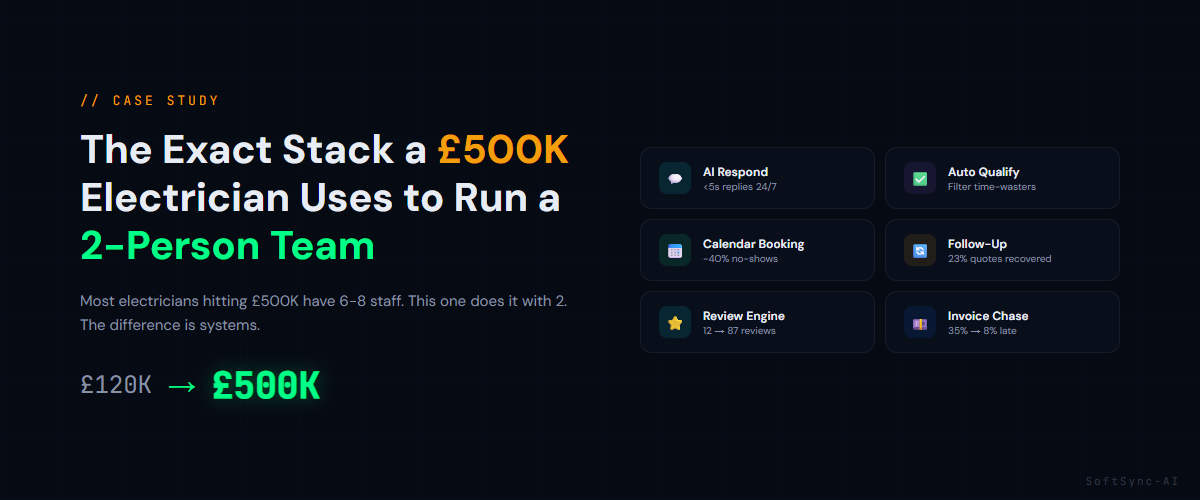
Most electricians hitting £500K/year have a team of 6-8. This one does it with 2 people. The difference isn’t talent — it’s systems.
Meet Jamie. He’s an electrician in Northampton. Three years ago, he was a solo sparky turning over £120K. Good work, fair prices, steady referrals. But he was working 12-hour days and spending his evenings buried in admin — returning calls, chasing quotes, sending reminders, begging for Google reviews.
Today, Jamie turns over £500K with one apprentice. He finishes most days by 5pm. His phone barely rings because his systems handle everything before it gets to him.
He didn’t get better at electrical work. He got better at running a business by removing himself from the things a computer does better than a human.
Here’s exactly what he built.
1. AI Respond: Every Enquiry Answered in Under 5 Seconds
Before automation, Jamie’s enquiry process looked like every other tradesperson’s: customer calls, phone goes to voicemail because he’s up a ladder, customer calls the next electrician on Google, Jamie loses the job before he even knows it existed.
His first automation was the most impactful. An AI-powered response system that monitors every channel — WhatsApp, SMS, email, and his website contact form — and responds to every single enquiry in under 5 seconds.
Not a generic “We’ll get back to you” autoresponder. A genuine, conversational AI that greets the customer by name, acknowledges their enquiry, and starts qualifying the job immediately.
Jamie doesn’t touch his phone while he’s on a job. He doesn’t need to. Every potential customer gets an instant, professional response — whether they message at 9am on a Tuesday or 11pm on a Saturday.
The result: he went from losing roughly 40% of inbound enquiries to capturing nearly all of them. That alone added £8K/month to his pipeline.
2. Automated Qualification: Filtering Out Time-Wasters
Not every enquiry is worth Jamie’s time. Before automation, he’d spend 20 minutes on the phone with someone who wants a single socket moved in a flat 45 miles away. Or he’d drive to a quote only to discover the customer wants a £50 job and expects it done for free.
Now, the AI qualification system handles this. Within the first conversation, it asks the right questions:
- Domestic or commercial? Jamie focuses on commercial and larger domestic — the AI steers small jobs to a recommended contact.
- Job type? Full rewires, consumer unit upgrades, EV charger installations, and commercial fit-outs are his bread and butter.
- Urgency? Emergency call-outs are flagged immediately and get priority booking.
- Postcode? Jamie works within a 25-mile radius of Northampton. Anything outside that gets a polite “unfortunately we don’t cover your area” with a recommendation.
By the time Jamie sees the enquiry in his inbox, it’s already qualified. He knows the job type, the budget range, the location, and the urgency. No more guessing. No more wasted site visits.
He estimates this saves him 6-8 hours per week that he used to spend on calls and quotes that went nowhere.
3. Calendar Booking: Jobs Booked Without Jamie Lifting a Finger
Once a lead is qualified, the AI checks Jamie’s Google Calendar and offers available time slots. The customer picks one. Confirmation goes out automatically. A reminder goes out 24 hours before.
No back-and-forth texts. No “I’ll check my diary and get back to you.” No forgotten bookings.
Before this system, Jamie’s no-show rate was around 15%. Customers would forget, double-book, or simply not bother cancelling. Each no-show cost him half a day’s revenue plus the diesel to get there.
With automated confirmations and reminders, his no-show rate dropped to under 4%. That’s 40% fewer wasted journeys. Over a year, it saved him thousands in lost time and fuel.
4. Follow-Up Sequences: Reviving “Dead” Quotes
Here’s a number that surprised even Jamie: 23% of quotes he thought were dead came back after automated follow-ups.
Before automation, Jamie would send a quote, wait a few days, maybe send a “just checking in” text, then move on. Most tradespeople do the same. The quote sits in someone’s email, they get busy, they forget, and the job either doesn’t happen or goes to whoever follows up.
Jamie’s system sends three follow-ups over 14 days:
- Day 3: A friendly check-in asking if they have any questions about the quote.
- Day 7: A value-add message — perhaps a tip about the job, or a note about upcoming price changes in materials.
- Day 14: A final “we’re holding your slot” message with a gentle nudge to confirm or let him know if they’ve gone elsewhere.
None of these feel pushy or automated. They read like Jamie sent them himself. And nearly a quarter of “lost” quotes convert — that’s jobs Jamie would never have seen again without the system.
At an average job value of £1,200, recovering even 3-4 quotes per month adds £3,600-4,800 to his monthly revenue.
5. Review Automation: From 12 to 87 Google Reviews in 8 Months
Jamie knew reviews mattered. Every tradesperson does. But actually asking for them? That’s awkward. You finish a job, the customer’s happy, you shake hands, drive off, and forget to send the review link. Or you send it three days later when the goodwill has faded.
Now, within 2 hours of marking a job as complete, the customer receives an automated message thanking them for their business and asking for a quick Google review. The message includes a direct link — one tap and they’re on his Google profile, ready to write.
If the customer doesn’t leave a review within 48 hours, they get one gentle reminder. That’s it — no nagging.
Jamie went from 12 Google reviews to 87 in 8 months. His rating climbed from 4.2 to 4.9 stars. That improvement alone pushed him higher in Google’s local pack, which means more organic enquiries, which means more work without spending a penny on advertising.
6. Invoice Reminders: Getting Paid Without Chasing
Late payments are the silent killer of trades businesses. Before automation, 35% of Jamie’s invoices were paid late — some by weeks. He’d spend evenings sending awkward “just a reminder” texts and making uncomfortable phone calls.
His automated payment system sends:
- An invoice immediately upon job completion with a direct payment link
- A friendly reminder at 3 days overdue
- A firmer reminder at 7 days overdue
- A final notice at 14 days overdue flagging late payment fees
Late payments dropped from 35% to 8%. Cash flow stabilised. Jamie stopped worrying about whether he could cover materials for next week’s jobs.
The Before & After Numbers
Here’s what changed across Jamie’s business in 18 months:
- Weekly admin hours: 15 → 2
- Jobs per month: 12 → 28
- Annual revenue: £120K → £500K
- Google rating: 4.2 → 4.9 (87 reviews)
- No-show rate: 15% → 4%
- Late payment rate: 35% → 8%
- Team size: 1 → 2 (Jamie + 1 apprentice)
- Evening admin: 2 hours/night → almost zero
Jamie didn’t hire a receptionist (£22K-28K/year). He didn’t hire an office manager. He didn’t hire a marketing agency. He built systems that do the work of 4-5 people for a fraction of the cost.
The Key Insight
“Jamie didn’t get better at electrical work. He got better at running a business by removing himself from the things a computer does better.”
Every hour Jamie used to spend on admin is now an hour on a job site — earning money. Every enquiry that used to die in his voicemail now gets captured and qualified. Every quote that used to vanish into the ether now gets followed up.
The work didn’t change. The systems around the work changed.
And that’s why Jamie runs a £500K business with 2 people while most electricians at that revenue have 6-8.
You Don’t Need to Hire 5 People
You need to automate the 5 things that eat your time:
- Answering enquiries — AI responds instantly, 24/7
- Qualifying leads — AI asks the right questions so you don’t waste time on bad-fit jobs
- Booking jobs — Customers book themselves into your calendar
- Following up — Dead quotes get chased automatically
- Collecting reviews and payments — Happens without you lifting a finger
The entire stack can be live in 3 days. Not 3 months. Not after a £50K software build. Three days.
If you’re a tradesperson working harder than you should be for the revenue you’re generating, the problem probably isn’t your skills. It’s your systems.
SoftSync-AI builds the exact automation stack described above for UK tradespeople — AI response, qualification, booking, follow-ups, reviews, and payment chasing. Live in 3 days.
Ready to automate?
Book a free 30-minute AI audit and we’ll map exactly which of these six systems would move the needle most in your business.
Let’s talk →