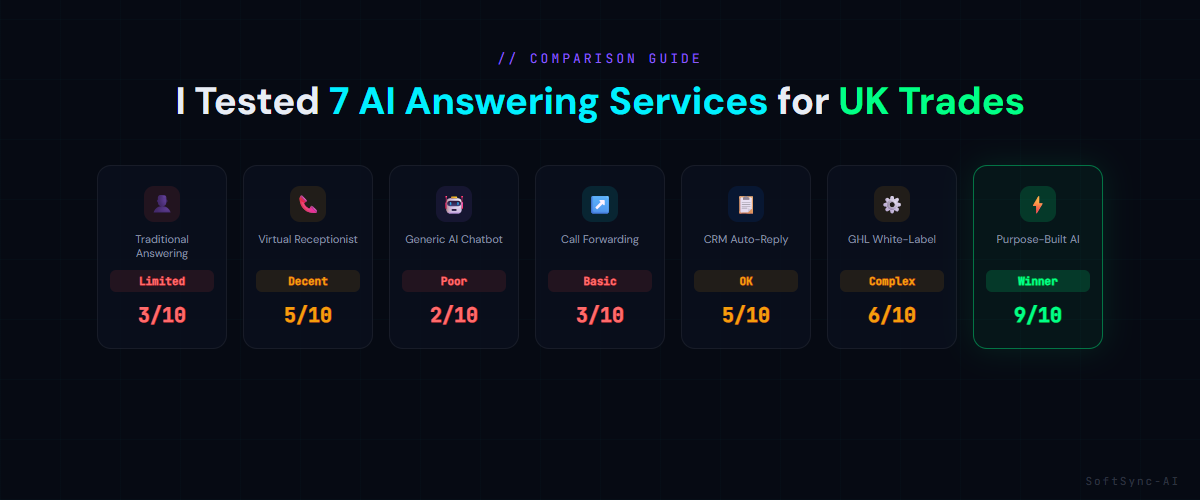
Before I built SoftSync-AI, I tested everything on the market. Every type of answering service, virtual receptionist, chatbot, and automation tool I could find — specifically for UK tradespeople. Here’s what I found.
If you’re a plumber, electrician, builder, or any kind of trades business owner looking for something to handle your calls while you’re on a job, this is the honest breakdown you need. No affiliate links. No sponsored rankings. Just what works, what doesn’t, and why.
I’ve grouped these into seven categories rather than naming specific brands, because the strengths and weaknesses tend to be about the type of solution, not the individual company.
1. Traditional Answering Services (Human Operators)
Cost: £200–£400/month
These are the old-school call centres. You divert your phone to them, a human operator picks up, takes a message, and emails or texts it to you.
What they do well: The human touch is genuine. Callers speak to a real person, which feels professional. Good for businesses that get complex or emotional calls where empathy matters. The operators are generally friendly and follow a script you provide.
What they miss: They can only take messages — they can’t book jobs into your calendar, check your availability, or send quotes. You still have to do all the follow-up yourself, usually in the evening. Most operate Monday to Friday, 9am to 5:30pm, which means weekends and evenings — when a huge chunk of emergency calls come in — go straight to voicemail anyway. They also only handle phone calls. If a lead comes through WhatsApp, Facebook Messenger, email, or your website contact form, it’s invisible to them.
Verdict: Better than voicemail, but you’re paying £200+/month for someone to take messages you still need to act on. And the 16 hours a day they’re not there? You’re back to square one.
2. Virtual Receptionist Services
Cost: £300–£800/month
A step up from basic answering services. These offer a dedicated receptionist (or small team) who learn your business, answer in your company name, and can handle slightly more complex interactions.
What they do well: They feel like having your own receptionist without the £25,000/year salary. Callers genuinely believe they’re speaking to someone in your office. The better services can handle basic FAQs, transfer calls to you when you’re free, and manage simple diary bookings if you give them access.
What they miss: Still limited to phone calls only. Still limited to business hours (some offer extended hours up to 8pm, but that’s extra). They struggle with trade-specific enquiries — asking the right qualifying questions about job types, urgency, and access requirements that a trades-savvy system would handle automatically. At £500+/month, you need to be booking several extra jobs to justify the cost. And if call volume spikes (say your Google Ads campaign kicks off), you’re paying per-minute overages that can balloon your bill.
Verdict: Genuinely useful if you can afford it and your leads come primarily through phone calls. But expensive, limited hours, and no coverage across messaging channels.
3. Generic AI Chatbots
Cost: £20–£100/month
The budget option. These are the little chat widgets you see on websites — usually powered by basic decision trees or early-generation AI. You set up a flow: “What service do you need?” → “What’s your postcode?” → “We’ll be in touch.”
What they do well: They’re cheap. They work 24/7. They capture basic lead information (name, number, what they need) that you’d otherwise lose entirely. For website visitors who prefer typing over calling, they provide a contact option.
What they miss: Customers hate them. I don’t say that lightly — the data backs it up. Over 70% of consumers report frustration with chatbot interactions, primarily because they sound robotic, can’t handle anything outside the scripted flow, and make people feel like they’re talking to a wall. They can’t book jobs. They can’t check your calendar. They don’t work on phone calls, WhatsApp, or SMS — only your website. And most UK trades leads don’t come through the website chat widget. They come through phone calls, WhatsApp messages, and Google Business Profile.
Verdict: Better than nothing on your website, but it only covers one channel and the experience is poor enough that it might actually put people off.
4. Call-Forwarding Services
Cost: £10–£50/month
The simplest option. These just forward your business calls to another number — your personal mobile, your partner’s phone, or a secondary device. Some add basic features like voicemail transcription or missed-call alerts.
What they do well: They’re dead simple. No setup complexity, no learning curve. If you have someone available to answer (a partner, a family member), this gets calls to them reliably. Some services include call recording for quality purposes, which can be useful for disputes.
What they miss: They don’t solve the core problem. If you’re under a boiler, forwarding the call to your other pocket doesn’t help. If your partner answers, they can’t check your availability, quote accurately, or book into your system. You’re just moving the ringing from one phone to another. The fundamental issue — nobody qualified is free to have an intelligent conversation with the caller — remains completely unsolved.
Verdict: Only works if you have someone else who can answer and knows your business. For most solo tradespeople, this just forwards calls to another voicemail.
5. CRM-Based Auto-Responders
Cost: £30–£150/month (as part of a CRM subscription)
Trade-focused CRM platforms often include an auto-response feature. When a call is missed, the system automatically sends a text: “Hi, thanks for calling [Business Name]. We’re on a job right now but will get back to you within the hour.”
What they do well: The auto-text is genuinely valuable. It acknowledges the customer, sets expectations, and buys you time. Some platforms go further — letting customers request a callback, view your availability, or fill out a job request form via a link in the text. The CRM integration means you can track the lead through your existing pipeline. These tools are built for trades businesses, so the workflows make sense for how you actually operate.
What they miss: The auto-text is a holding pattern, not a solution. The customer still has to wait for you to call back — and as we know, 78% of customers book with whoever responds first. If your competitor answers their call live while the customer is waiting for your callback, you’ve lost the job despite having a fancier text message. These systems typically only handle SMS and sometimes email — no WhatsApp, no Facebook Messenger, no voice. And they don’t have a conversation. They send a template. There’s no qualifying, no booking, no intelligence.
Verdict: A solid feature within a CRM you’re already using. But it’s a sticking plaster, not a fix. It reduces the damage from missed calls but doesn’t eliminate it.
6. All-in-One Marketing Platforms (White-Label)
Cost: £200–£500/month
These are the big, complex platforms that agencies use to manage client communications. They offer everything: CRM, email marketing, SMS campaigns, reputation management, booking funnels, workflow automation, and increasingly, AI-powered conversation tools. Many trades businesses encounter them through a marketing agency that white-labels the platform under their own brand.
What they do well: The capability is enormous. In theory, you can build exactly what you need — automated responses across every channel, intelligent lead qualification, calendar booking, review requests, the lot. For someone who knows the platform well, it’s like having an entire marketing department in software.
What they miss: They’re not designed for tradespeople. They’re designed for marketing agencies. The setup complexity is staggering — we’re talking weeks of configuration, workflow building, and testing to get something reliable. Most tradespeople I’ve spoken to who tried this route either gave up during setup, paid an agency £1,000+ to configure it, or ended up with a half-built system that broke every time something unexpected happened. The learning curve is steep, the interface is overwhelming, and when something goes wrong (and it does), debugging requires technical knowledge most trades business owners don’t have. You also pay for a mountain of features you’ll never use — email marketing, funnel builders, survey tools — when all you actually need is “answer my phone and book the job.”
Verdict: Incredibly powerful, but wildly over-engineered for what a tradesperson needs. Like buying a Swiss Army knife with 47 tools when you need a screwdriver.
7. Purpose-Built AI Automation for Trades
Cost: £150–£350/month
This is the newest category — and the one I ultimately built SoftSync-AI into. These systems are designed from the ground up for one specific job: making sure trades businesses never miss a lead, no matter what channel it comes through.
What they do well: Everything happens automatically, across every channel. A call comes in while you’re on a job? AI responds in under five seconds with a natural conversation — not a robotic script, but an actual back-and-forth that understands plumbing, electrics, building work, and the questions customers actually ask. WhatsApp message at 11pm? Same thing. Facebook enquiry on a Sunday morning? Handled. The AI qualifies the lead (what’s the job, what’s the urgency, what’s the location), checks your live calendar, books the appointment, and sends a confirmation to both you and the customer. It follows up with customers who went quiet. It requests Google reviews after completed jobs. It runs 24/7/365, never takes a day off, and handles every channel simultaneously.
What they miss: Let’s be honest about the limitations. AI isn’t perfect at handling highly emotional or complex conversations — a distressed customer dealing with a flood might want a human voice. The technology is still evolving, and edge cases exist where the AI might misinterpret a request. Setup requires some initial configuration (your services, pricing ranges, service area, calendar) — though this is hours, not weeks. And there’s a trust factor: some customers, particularly older demographics, may prefer speaking to a human. That said, the data shows that speed of response overwhelmingly trumps the human-vs-AI distinction — customers would rather get an instant intelligent reply than wait four hours for a human callback.
Verdict: The most complete solution for the specific problem trades businesses face. Covers all channels, responds instantly, qualifies and books automatically, works around the clock. The cost sits between a basic answering service and a virtual receptionist, but delivers significantly more.
How I Scored Them
I evaluated each type against six criteria that matter most to a UK trades business owner:
- Response speed: How quickly does the customer get a meaningful response? (Not just “we’ll call you back” — an actual conversation.)
- Channel coverage: Does it handle calls, SMS, WhatsApp, email, Facebook, and website enquiries? Or just one?
- Booking capability: Can it actually book a job into your calendar, or does it just take a message?
- UK trades knowledge: Does it understand the difference between a first fix and a second fix? Does it know what questions to ask for an emergency boiler repair vs. a bathroom refit?
- Ease of setup: Can a non-technical tradesperson get this running without hiring a consultant?
- Monthly cost: What’s the all-in price relative to the value it delivers?
No single solution scores perfectly across all six. But the gap between the best and worst is enormous.
What the Ideal Solution Actually Looks Like
After testing all seven types, here’s what I concluded the ideal answering solution for a UK tradesperson needs to do:
- Respond in under 10 seconds — on any channel, at any time of day
- Have an intelligent conversation — not a script, not a template, but a real back-and-forth that qualifies the job properly
- Book directly into your calendar — checking your live availability, not just “taking a message”
- Work across every channel — phone, WhatsApp, SMS, email, Facebook, website — because leads come from everywhere
- Understand UK trades — know the terminology, ask the right questions, handle emergency vs. standard requests differently
- Run 24/7/365 — because pipes burst at midnight, boilers die on Christmas morning, and a lead that comes in on Saturday shouldn’t wait until Monday
- Cost less than the jobs it saves — if it recovers even two or three leads per month, it should more than pay for itself
- Be simple to set up — hours, not weeks. No technical expertise required.
That’s the checklist I used when I built SoftSync-AI. Not because I wanted to tick marketing boxes, but because after testing everything else, these were the gaps that genuinely needed filling.
The Honest Takeaway
Every option on this list is better than doing nothing. If you’re currently sending every missed call to voicemail and returning calls at 9pm, any of these solutions will improve your situation.
But if you want to actually solve the problem — not just reduce the damage — you need something that responds instantly, across every channel, with enough intelligence to qualify the lead and book the job without your involvement.
That’s not a sales pitch. That’s just what the data shows. Speed wins. Channel coverage wins. Automation wins. Everything else is a half-measure that still leaves money on the table.
Whatever you choose, choose something. Every day you rely on voicemail is a day you’re handing jobs to the competition.
SoftSync-AI responds to every call, text, and message in under 5 seconds — so UK tradespeople never lose a job to a missed call again. Live in 3 days.
Want to see how it works?
Book a free 30-minute AI audit and we’ll show you exactly how SoftSync-AI would handle your leads across every channel — calls, WhatsApp, SMS and web.
Let’s talk →